<meta name="p:domain_verify" content="987e208cbfc957656b212a7251d991ee"/>

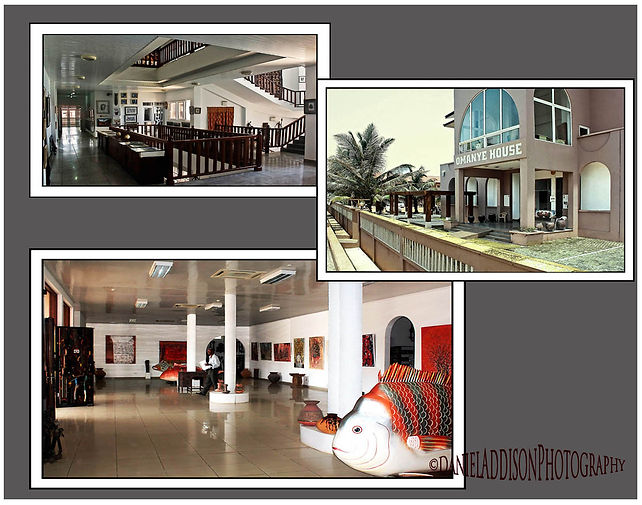
THE ARTISTS ALLIANCE GALLERY.
If you are at all interested in contemporary art or fine art, you may have already heard about the Artists Alliance Gallery.
One of Ghana's most respected artists, Ablade Glover is responsible for this establishment.
Every Ghanaian artist worth their salt is represented in the gallery. You can buy most of the art you see here direct from the artist. They ship all over the world and accept credit cards
Admission is free and the gallery is opened daily. It is located near the Labadi Beach Hotel on the Labadi beach road,
Click on my images as usual to find out a bit more about the Artists Alliance.
OMANYE HOUSE
CONTEMPORARY ART IN GHANA
From a general perspective, one may be tempted to categorize Ghanaian visual artists into groups due to which generation they belong to, or the stylistic similarities and differences, within their work.
There are evidently aesthetic differences in the works of artists who receive training at academic institutions and those who go through apprenticeship at sign writing workshops.
These differences are not necessarily qualitative but rather stylistic alternatives made by the artists as a result of the opportunities and circumstances they encounter, a conclusion that may displease two schools of thought, firstly, those who believe that College education absolutely yields art of the highest calibre, and secondly those who deride formal training as adulteration and derivative of Western ideas, hence inauthentic.
The idea of grouping Ghanaian artists is an anomaly because of its complexity. The artistic climate of Ghana is made up of a variety of styles. This stylistic pluralism may be due to several factors and influences such as ethnicity, religion, education, westernization, globalization and aesthetic preferences of the individual artist under consideration.
The complex social structure of the Ghanaian society is due in part to the fact that there are about 79 languages spoken in a country whose population is a little over 20 million. The Ghanaian cultural melting pot is compounded by the fact that several religions are being practiced.
It is within this social fabric that most Ghanaian artists coexist and evolve their aesthetic ideas.
Stylistic groupings create problems such as marginalization, especially when such divisions reference the hierarchy of what is, and what is not art, a barrier that pushes some artists to the periphery and favours a few others.
The intent, purpose and dynamics of ongoing African art has changed to become much more eclectic because of the continent's experience with proselytism, slavery, and colonialism. Art of any historic era is a direct reflection of the circumstantial ambience past and present within that very setting.
Culture is dynamic and susceptible to influence and change. Current art created in Africa is a fabric of the cosmopolitan melting pot, a protean of its past, a reality of its present and a determinant of its future. To this effect, therefore contemporary Ghanaian visual art is a direct offspring of the poly-traumatic African chronicle.